
The Org Chart is Temporary, The AI Roll-up Thesis, and The Startup Playbook Is a Trap
built to be rebuilt.
Good morning
A change. Starting April 1st, 2026, I’m pausing all paid subscriptions on Substack. If you’re a paying subscriber, you won’t be charged again (if technically all goes well :)).
You’ll still get a full year of paywalled content through April 1st, 2027. After that, the newsletter goes fully free for the first time since I started writing it in 2018, on a biweekly schedule.
In today’s edition, among other things:
The Org Chart Has a Half-Life
The AI Roll-up Thesis
The Startup Playbook Is a Trap
Securing AI Agents: The Defining Cybersecurity Challenge of 2026
Founder-Led Sales Playbook: Repeatable Motion
Corporate Venture Capital: A User Guide
Onwards!
The Org Chart Has a Half-Life
The org chart itself is becoming a temporary structure, compressed and redrawn faster than any management theory can keep up with.
The numbers from Foundation Capital’s research are crazy. One company is shrinking a 120-person engineering team to 25. Another running 30+ microservices has gone from 0.75 engineers per service to a projected 0.1, meaning a single engineer overseeing what used to require eight. A company with a 1:6 expert-to-generalist ratio today is targeting 1:25 within twelve months and eventually 1:100.
Those ratios describe a different kind of organization, one where traditional role boundaries dissolve rather than stretch.
Foundation Capital uses the electricity-and-factories analogy: most companies are still running AI on organizational architectures designed for a pre-AI world. Faster individuals don’t automatically produce a faster org when the handoffs, approval chains, and role boundaries stay the same. The taxonomy of what comes next is where it gets useful.
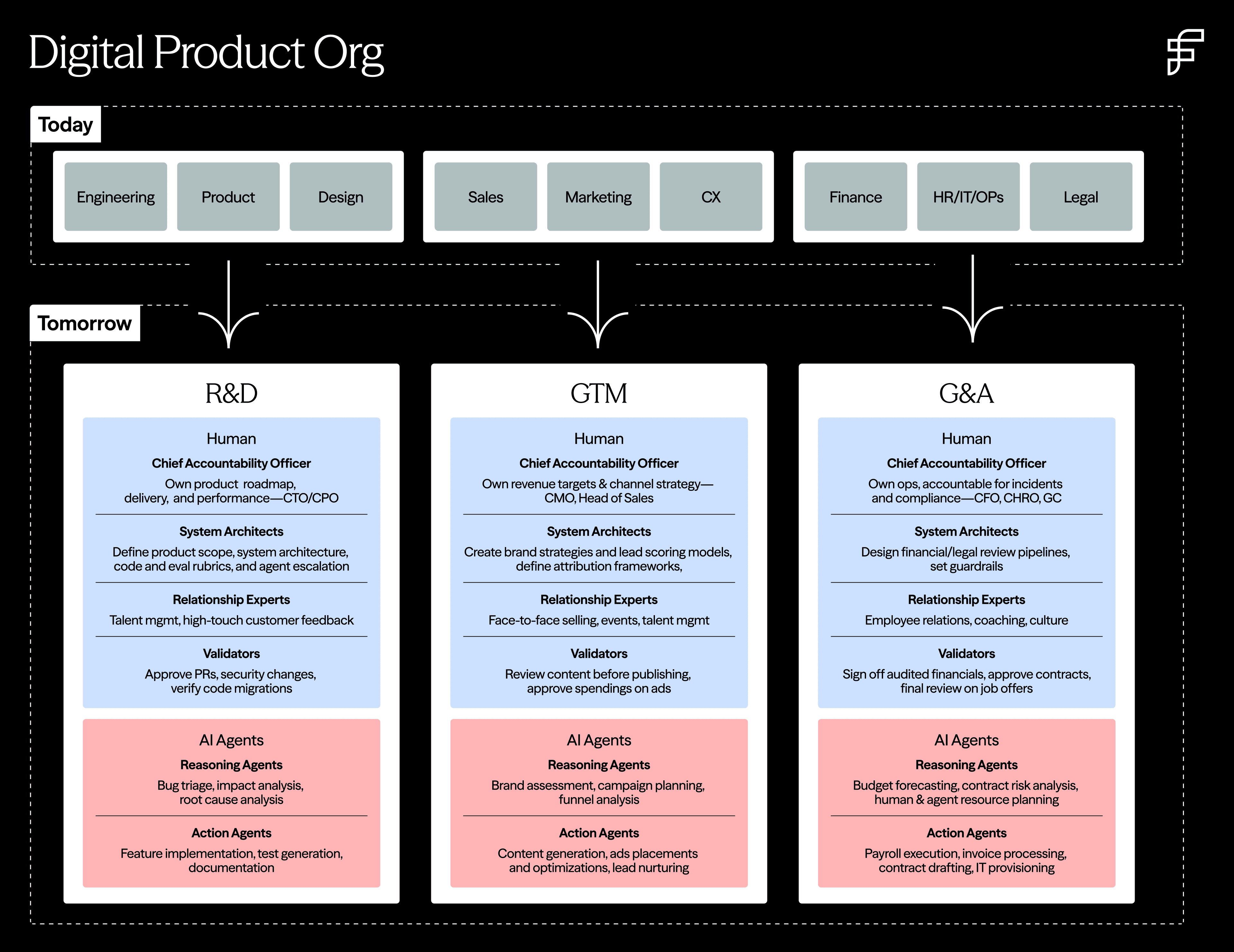
They propose four human roles that survive the compression: accountability officers (executives who own outcomes and sign filings), systems architects (people who design human-agent workflows), relationship experts (sales, account management, culture builders), and validators (humans who review and approve agent output). Nine traditional functions collapse into three: R&D, GTM, and G&A.
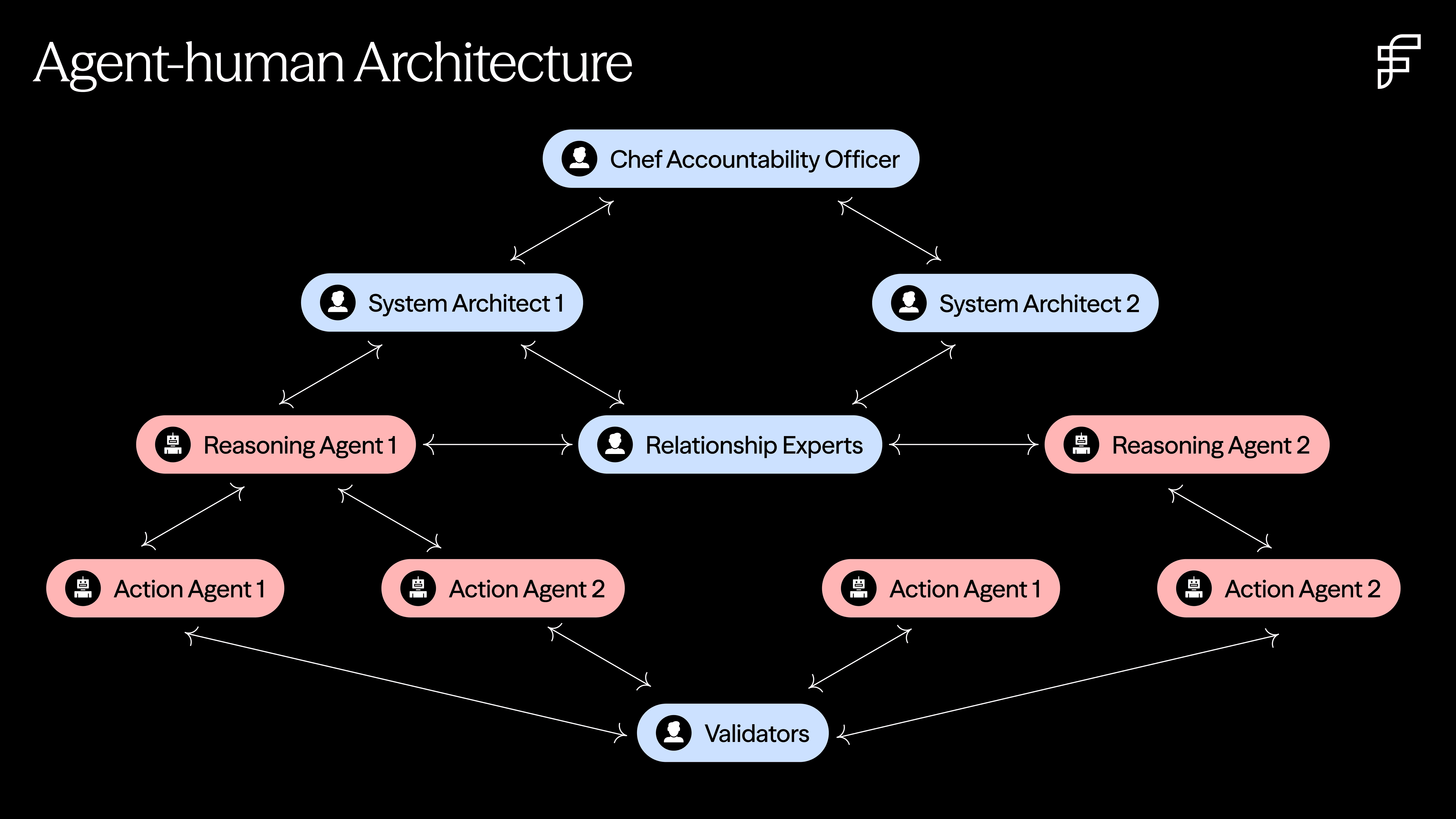
The validator role is the most interesting because it comes with a built-in paradox. Foundation Capital expects validator demand to follow a bell curve: ramping now, peaking in two to four years as agent deployments scale, then declining as systems accumulate enough data to self-correct. But the people qualified to validate are experts who built that expertise by doing the work themselves. If agents handle all the junior analyst work and first-draft code, the class of 2035 never gets those reps.
The validator pool is a one-generation asset unless we deliberately replenish it.
Every AI transformation roadmap assumes a supply of qualified validators that the transformation itself is depleting. The mandate at one 1,000-person company that every PM and designer must ship code using AI tools (”My First Pull Request”) is a partial answer. But building an app with Cursor is not the same as understanding why a system fails at 3 a.m.
The piece also maps a useful 2x2: product vs. service companies, digital vs. physical delivery. Digital services (consulting firms, BPOs, agencies) face the most immediate pressure because the product is the work itself, and agents are doing it. Digital product companies compress headcount but keep human oversight in the loop. Physical services are furthest from full automation but have the clearest opportunity for orchestration around scheduling and routing.
The startup opportunity that stands out is agent-native tooling. Foundation Capital notes that an MCP tool schema can consume roughly 55,000 tokens just to load, while the equivalent CLI command costs around 200. Bolting MCP onto Jira still routes agents through data models built for human cognition. The companies that build tools where agents are the primary user, with human oversight as a feature rather than the default interface, will outperform on raw throughput.
The companies in this research are restructuring roles, collapsing functions, and rethinking what “headcount” even means.
Source: The Great Reorg: A Human’s Guide.
The AI Roll-up Thesis
A “roll-up” is an old private equity playbook: buy a bunch of small businesses in the same industry, combine them under one roof, and extract value through scale. Consolidate back-office, centralize purchasing, apply one management layer across many locations. PE firms have done this for decades with dental practices and veterinary clinics.
An AI roll-up adds a different lever. You acquire small service businesses, the kind where most of the cost structure is people doing knowledge work: accounting firms, property managers, IT support shops, insurance brokers, logistics coordinators. Then you apply AI to automate a meaningful chunk of that work. A bookkeeping firm running on 15% EBITDA margins might get pushed toward 40-50% if AI handles the routine data entry, reconciliation, and reporting that currently requires junior staff. The difference from a traditional roll-up: you’re transforming the cost structure of the acquired business itself, not just consolidating overhead across a portfolio.
The model went from obscure to unavoidable in 2025. Google Trends for “AI roll-up” went from near-zero to peak interest in under a year, and over 150 companies are now on the AI Roll-up Nexus tracker. The economics are straightforward: services businesses trade at 4-6x EBITDA, so you buy cheaply, double margins through AI automation, and sell the combined entity at a higher multiple.
But the capital to prove the model arrives after the proof is already done.