
The Tiny Teams Playbook, Why You Can’t Focus at Work and The Full-Stack Person
It’s never too early to build things.
Good morning,
In today’s edition, among other things:
Things That Aren’t Doing the Thing
The Tiny Teams Playbook
Why You Can’t Focus at Work
The Full-Stack Person
How to Lead Remote Teams
How to Set Goals for 2026
How to Use AI Agents for Marketing
How to Pick a Company Name
Onwards!
Things That Aren’t Doing the Thing
A reminder I’m reposting every now and then for everyone of us:
Preparing to do the thing isn’t doing the thing.
Scheduling time to do the thing isn’t doing the thing.
Making a to-do list for the thing isn’t doing the thing.
Telling people you’re going to do the thing isn’t doing the thing.
Messaging friends who may or may not be doing the thing isn’t doing the thing.
Writing a banger tweet about how you’re going to do the thing isn’t doing the thing.
Hating on yourself for not doing the thing isn’t doing the thing. Hating on other people who have done the thing isn’t doing the thing. Hating on the obstacles in the way of doing the thing isn’t doing the thing.
Fantasizing about all of the adoration you’ll receive once you do the thing isn’t doing the thing.
Reading about how to do the thing isn’t doing the thing. Reading about how other people did the thing isn’t doing the thing. Reading this essay isn’t doing the thing.
The only thing that is doing the thing is doing the thing.
The Tiny Teams Playbook
Seven teams. One hundred people total. Two hundred million dollars in ARR. That’s $2M in revenue per employee, a figure most venture-backed startups never approach. Something new is happening with AI: teams with fewer than 30 people are quietly shipping products used by tens of millions and generating nine-figure revenue. Turns out tiny teams work only when you treat headcount as a last resort and automate everything else.
It’s the architecture of those teams that makes speed possible.
In the Tiny Teams Playbook, seven companies with roughly 100 people in total generate about 200m ARR across products like Gamma, Bolt, Gumloop and Datalab.
Wang describes Tiny Teams as “the co-op multiplayer game… capable of more adaptability, resilience and ‘damage per second’.”
That metaphor is important. Tiny teams are tuned for output per unit of trust, not output per unit of time. Every extra person is another network edge to maintain. So they bias hard toward:
“Small (<15) crew of senior generalists: much fewer juniors”
You are not building a pyramid. You are drafting a raid party. Broad, experienced players who can own whole loops: talk to users, ship product, wire the data, fix the infra. Juniors do not vanish forever, but they arrive later, once the game is well defined.
That is, if you have the right kind of experience in building. You can build an organization that can assume agents and automation are the default and humans are the exception.
Here’s the advice from the companies that managed to do this:
Hiring
Hire right or not at all: have to be excited about the candidate or it’s a no
Work Trials: paid projects for 4days-3months to be sure it’s a good fit
Product-Led Hiring: top customers who quit their jobs to join you
Top of market salaries: 95th+ percentile salaries
Small (<15) crew of senior generalists: much fewer juniors
Culture & Value: keep a living culture deck and live it
Low ego, high trust: trust = speed, ownership
Independence, Grit & Resilience: ignore standard VC advice, persevere
Radical transparency and accountability: wall of work, show & tells
User focus: Work closely with users, celebrate them, delight in feedback
Camaraderie, speed: Have fun, do retreats, avoid burnout
Operations
Almost no meetings: “deep focus” - building instead of talking about building
AI Chief of Staff: automate research, marketing etc w/ Gumloop or Lindy
AI Support: very well fleshed out at this point. e.g. see Parahelp and Railway
Let Fires Burn: in order to prioritize on the 10% critically important
Compound learning: Oleve phrases it “Don’t Learn It Twice” - build reusable templates and playbooks
In Person: either have an office, or VERY frequent AirBnB hack weeks
Tech and Product
Simple, Boring Tech Stack: shell scripts over k8s, keep code modular.
Simple Product: start from UI wrapper over one API call to a LLM.
Feature Flags/Experimentation: one of Oleve’s core principles.
Benchmarks: create top tier internal evals for LLMs/harnesses. Market them.
The mechanism is simple: every recurring cognitive task is either eliminated, templatized, or given to an agent. The scarce resource in an AI native company is managerial bandwidth, not compute. Once you see it this way, it becomes obvious why these teams can stay tiny with huge surface area.
Why You Can’t Focus at Work
Microsoft’s 2025 Work Trend Index found that heavy collaborators face interruptions every two minutes. That’s 30 interruptions per hour. Run that through a basic productivity model and the output is zero: no 60-minute focus blocks, no deep work, no compound thinking. There are no productivity YouTube videos and books that can help you.
Our inability to focus isn’t a discipline problem, but a math problem, and the math says we’re operating in a system designed to prevent focused work.
Can Duruk’s simulation model reduces workplace productivity to three parameters: λ (interruptions per hour), Δ (minutes to recover focus after each interruption), and θ (minimum uninterrupted time required for meaningful work). The interaction between these variables explains why some days feel productive while others vanish into gray noise.
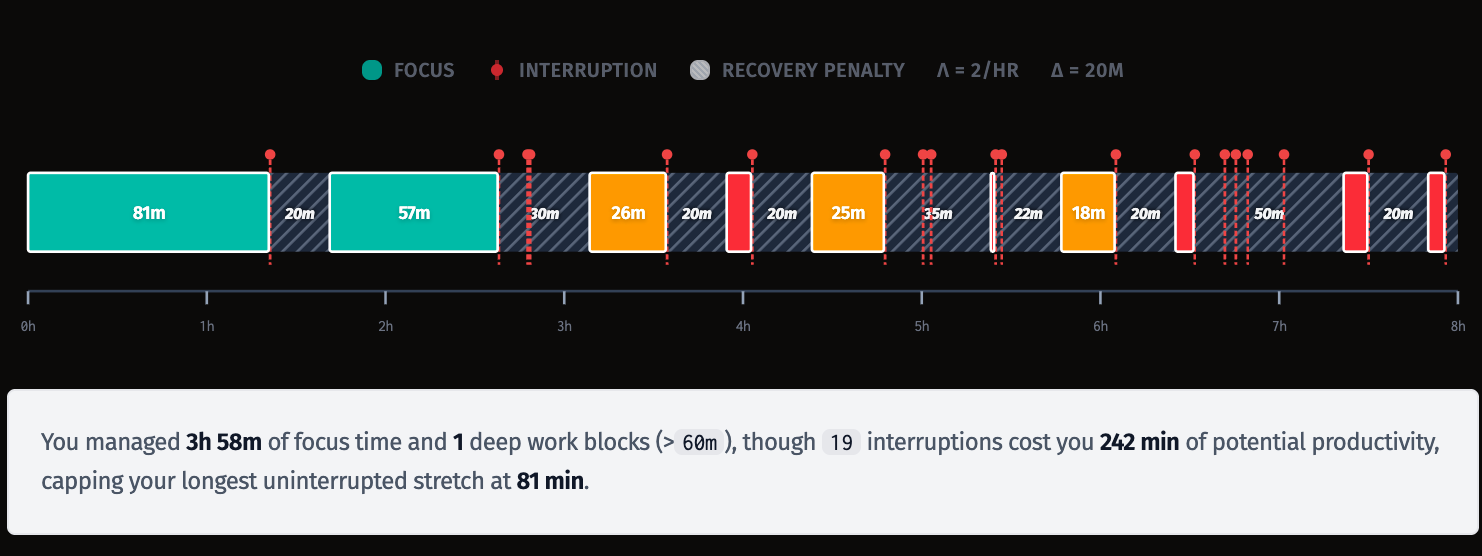
“Even a ‘quick two-minute question’ can cost you 15–20 minutes of recovery time.”
This asymmetry is the core mechanism. The interruption itself is trivial. The recovery penalty is catastrophic. At λ=2 (two interruptions per hour) and Δ=20 (twenty-minute recovery), Duruk’s simulations show workers getting roughly one 60-minute focus block per day. That’s from an 8-hour workday.
Seven hours of “working” produces one hour of actual work.
Read that again.
Seven hours of “working” produces one hour of actual work.
The relationship isn’t linear. Dropping from λ=2 to λ=1, just one fewer interruption per hour, increases the probability of getting three deep-work blocks from 14% to 70%. One interruption per hour is the difference between a sustainable system and a broken one.
Here’s a good day for comparison:
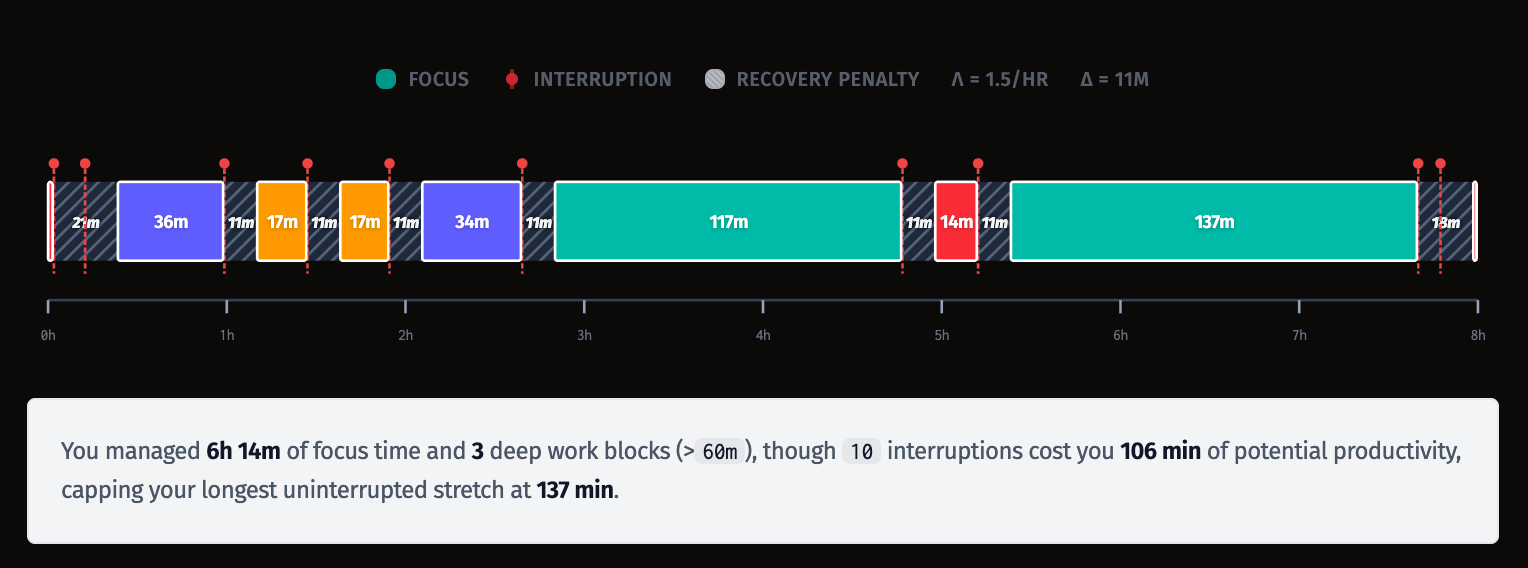
The simulations use λ=2 or λ=3 as “typical” scenarios. Academic research suggests these are best-case assumptions.
“González & Mark found workers switch activities every 3 minutes on average. Iqbal & Horvitz measured 7.5 email/IM alerts per hour, with 10–16 minutes needed to resume work after each.”
That’s from 2004 and 2007. Since then, we’ve added Slack, Teams, always-on video calls, and a culture that treats every message as urgent. The Microsoft data showing λ=30 for heavy collaborators isn’t an outlier. It’s the new normal for anyone in a coordination-heavy role.
The core shift is to treat λ, Δ, and θ as tunable variables.
Run the simulation at λ=15 with Δ=25 and the entire 100-day grid turns gray. No focus blocks of any length. The visualization looks broken because the reality is broken. We’ve normalized an environment where focus has been engineered out of the workday.
The González study found that nearly half of knowledge worker interruptions are self-inflicted. Checking email twice daily instead of continuously is the highest-leverage change most people can make. Train your teammates that your attention requires effort to access. This feels hard until you measure the alternative.
If your product or productivity strategy assumes deep thinking but your operating environment is calibrated for constant reaction, you have a math contradiction coming from not understanding what’s happening, not a culture problem.
First, attack λ. Second, reshape θ by decomposing work. Third, trim Δ. It’s math.
The Full-Stack Person
Contrary to popular LinkedIn posts, AI did not suddenly make everyone a 10x engineer. AI removed your excuse for not shipping.
The durable advantage now is becoming a full-stack person: someone who owns the problem end-to-end and uses AI to move faster across product, engineering, and customer reality.